Sunday, January 30, 2011

The P’s and Q’s of Crochet Hooks

I was asked when crochet hooks grew to sizes P and Q. Looking back through my research, here’s a summary of what I found. Please leave a comment if you can add to the information on large crochet hooks.

In the late 1930’s large wooden hooks started appearing to be used in rug making. The nine inch hooks were given the number sizes 10, 11, 13, 15 and 16 ─ no letters. When these were re-introduced in the late 1980’s the numbers had letters added so that J=10, L=11, M=13, N=15.

Size N and Q hooks began to show up in the mid 1970’s in product lines of the major hook manufactures. The Bates’ Jiffy hooks in sizes Q (15) and S (17) appeared in the late 1970’s.


Also in the late 1970’s the Handy Hook was introduced in sizes K, N, & Q and re-introduced in the early 1990’s.


Crochet hook sizes L, N, Q & S appear in the early 1980’s and the P (16) hook makes it debut. Q changes to a 19 but the millimeter size is given as 16 millimeter. Size S hook changes to 35 or 19 millimeter. The S hook was reintroduced in the early 2000’s as a “Speed Hook” by Lion Brand.

As you can see, the P and Q as well as the L, M, and N sizes fluctuated. Now, the Craft Yarn Council has standardized the sizes in millimeters as well as the letters/numbers. The following chart from the Craft Yarn Council shows the current hook size information.


The Yarn Council has solved the sizing issue on the P and Q hooks. What about the R? As you can see from the above chart, there is a jump in millimeter size from the Q to the S. My guess? Maybe they can’t come up with a consensus on what size the R should be.

Wednesday, December 29, 2010

Another Rare Boye Hook

World War II involved most countries around the world and lasted from 1939 to 1945. The United States entered the war after the Japanese attack on Pearl Harbor, December 7, 1941.

In May of 1942 an order by the United States Government impacted the manufacture of crochet hooks by stopping nickel plating. In an attempt to keep manufacturing needlework tools, Boye developed a black plating process using hot oxide to coat steel needlework tools, including crochet hooks, and used this method to continue manufacturing from June 1942 until the United States Government halted production of all steel products in August 1942. Due to the short time of manufacture, “black” Boye crochet hooks are prized by crochet hook collectors in general and Boye hook collectors in particular.


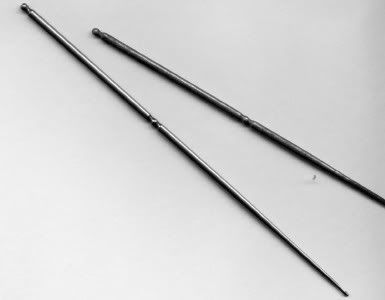
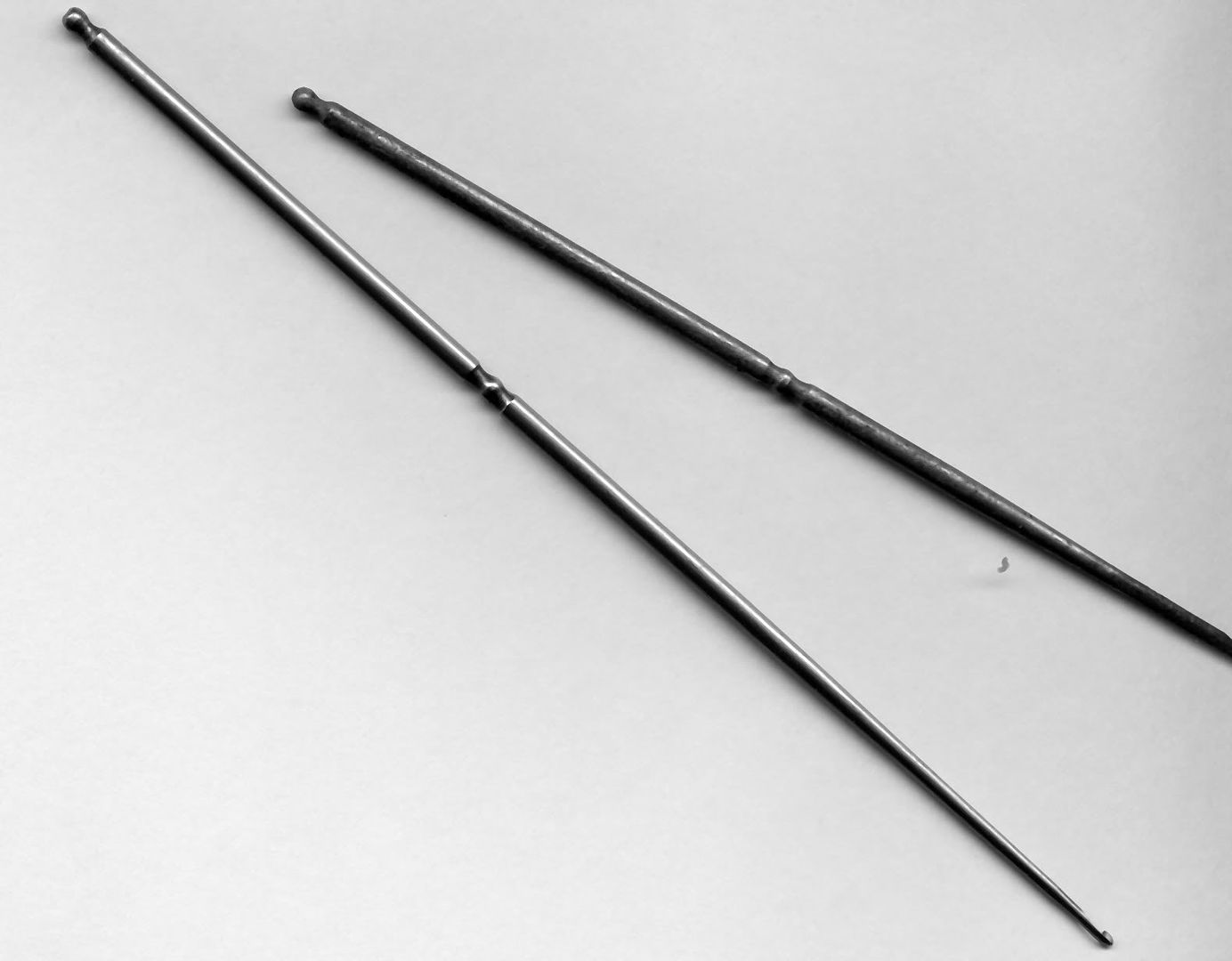
"Black" Boye crochet hook in removeable vintage hook handle.

Monday, January 19, 2009

The Start of My Quest

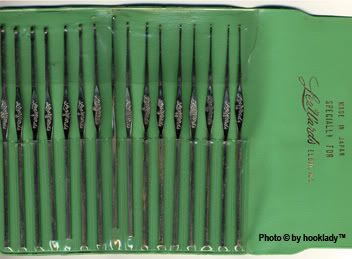
My research and study of crochet hooks began with a missing hook. My sister bought this set of Lee Ward hooks for my Mother in the 1960’s.


When I inherited them from Moma there was one hook missing. Most crocheters want a complete set of hooks whether used or not. And like most crocheters, I wanted the set to be complete. This started a quest to find a hook to replace the missing one. I looked in antique stores, thrift shops and finally on eBay.

Shortly after I started the quest, I discovered the hook was never missing I had put it with my other hooks by mistake. By then I was hooked on finding out if hooks could be dated based on their markings and I was off on a research project that continues to this day.

Wednesday, December 24, 2008

For the Susan Bates Crochet Hook Collector

So the Susan Bates hook lovers do not feel left out this blog is dedicated to Susan Bates vintage hooks. And if you are lucky, you might run across a vintage Susan Bates store display case to house some of your hooks.


The C. J. Bates Company started out making bone hooks. Sometimes referred to as Ice Cream Cone hooks because of their shape, these bone hooks are not too difficult to find. However, what is almost impossible to find are hooks in pristine condition like the ones in this picture.


Clipson hooks are also collector items. There are two kinds, one with the metal clip and later ones with a plastic clip.


Some other vintage Bates hooks…


  1. Anchor Crochet Hook …steelite crochet hook in a handle.
  2. Quicksilver … the Susan Bates version of the Teflon coated crochet hook.
  3. Early Plastic … pre in-line plastic hook.

And last but not least...early plastic afghan hooks.


As you can see from this sampling, there is enough variety of vintage made in the USA Susan Bates crochet hooks to keep a collector looking for a long time.

Sunday, December 21, 2008

Rare Size 15 Boye Crochet Hook

In my research on crochet hooks I came across a reference to Boye introducing a size 15 crochet hook in late 1924. About 5 years ago, I finally found one.


Then, yesterday I was sorting through some hooks I bought on eBay a couple of years ago. If I hadn't procrastinated so long, I would have discovered that buried with the hooks was another size 15 Boye hook. This one has markings indicating it was made after 1925.


In your search for hooks to add to your collection, see if you can find one of the rare Boye size 15 hooks.

Saturday, December 06, 2008

Difference Between Vintage and New Susan Bates Inline Hooks

I have had several people question the differences in vintage inline Susan Bates hooks and the new ones made in Mexico. Soooo...I am going to attempt an explanation .

The difference is more evident in the steel hooks.


The top hook is the made in Mexico hook, the middle is made in Japan and bottom is made in the USA. The USA one has a shorter shank and flatter throat than the other two. The others have more of a scoop for the hook than the classic inline shape of the USA hook.

Aluminum hooks...


are very similar (top is USA) (bottom is made in Mexico). The one made is Mexico has a more pointed head and the throat is not quite as flat. Also the throat on the one made is Mexico is a little shorter than the USA hook and though it doesn't show on the picture there is more space for the yarn in the USA hook.

Sunday, November 30, 2008

Every good girl deserves a Boye...

is an ad from the 1950's for Boye crochet hooks. In addtion to the standard aluminum and steel hooks... here are some hooks you might want to add to your collection..

Bone Hooks


Steel Yarn Hooks
Interchangeable Hook Set showcased at the 1933 World's Fair.

Friday, November 28, 2008

Boye Interchangeable Hooks What's Old Is New Again

I used a Hobby Lobby 40% off coupon to buy the a new Boye interchangeable crochet hook set.

I just had to have a set to compare to the set that Boye made in the 1930's.


What do you think?

I like the case on the new hooks but think the old ones are better looking.

You can order the new INTERCHANGEABLE HEAD CROCHET HOOK SET from Amazon...the vintage one you'll have to order from me.

Wednesday, May 07, 2008

Cleaning Steel Crochet hooks

I was asked how to clean a vintage steel crochet hook on the Crochetville Forum. This was my answer.


To get rid of the rust, I dip only the discolored area of the hook in CLR or Lime Away for a few minutes then take an old toothbrush and a little dish detergent and clean it good.

Next, using "0000" steel wool moistened with a few drops of WD40 or a good machine oil, I rub the area well (this could take a while). Then I coat the hook with a little Blue Magic Metal Polish Cream let it dry and buff with a clean dry cloth.

If the hook is still discolored, I use a finger nail buffer or jeweler's cloth or both and buff it. I repeat the use of the steel wool and the buffer until the area is smooth.

Once all the rust is removed, I use the metal polish again and then wax it well. The best wax to use is Renaissance wax, the second best is bee's wax, next best is rub it well with waxed paper.

Remember that rust indicates that the protective coating on the hook has been destroyed and it will need to be washed regularly, protected with a good metal polish and kept waxed to prevent it from rusting again.


I restored the bottom hook in the picture using this method, when I started it looked worse than the top hook . Here is a link to a bigger picture with more detail.

Tuesday, April 08, 2008

Boye Vs Bates

A long debate is ongoing between crocheters regarding which is the better hook to use Boye or Bates. The debate continues and fans on both side will not give up their favorite.

The debate is over the shape of the hook, but I think the discussion should center around the length of the shank. Bates hooks have a short shank and Boye hooks have a long shank. Therefore how you hold your hook and the motion of making the stitches are affected by the length of the shank, if you hold your hook by the flat.


Try an experiment the next time you want to throw your Boye or Bates hook out.
  • First, clean and wax your hook.

  • Next, move your grip off the flat and, if you are using a Boye hook and are used to using a Bates one, move your grip up the shank to about where you would hold your Bates hook. If you are using a Bates hook and are used to using a Boye, do the opposite. Move your hand down the shank. This might help you get through your project without throwing you hooks out.


William E. (Bill) Elmore in his books The Elmore Method of Crochet and More Elmore recommends having both short shank and long shank hooks in your crochet hook collection. I agree.